
Sermorelin
Muscle & Growth
The body's own growth hormone, prompted.
- Signals the pituitary rather than replacing the hormone
- Studied for lean mass and body composition
- Commonly reported effect on sleep quality
- Injectable and oral routes available
Your goals. Your biology. A clinician-led approach to peptide therapy, personalized to your labs, history, and performance priorities.
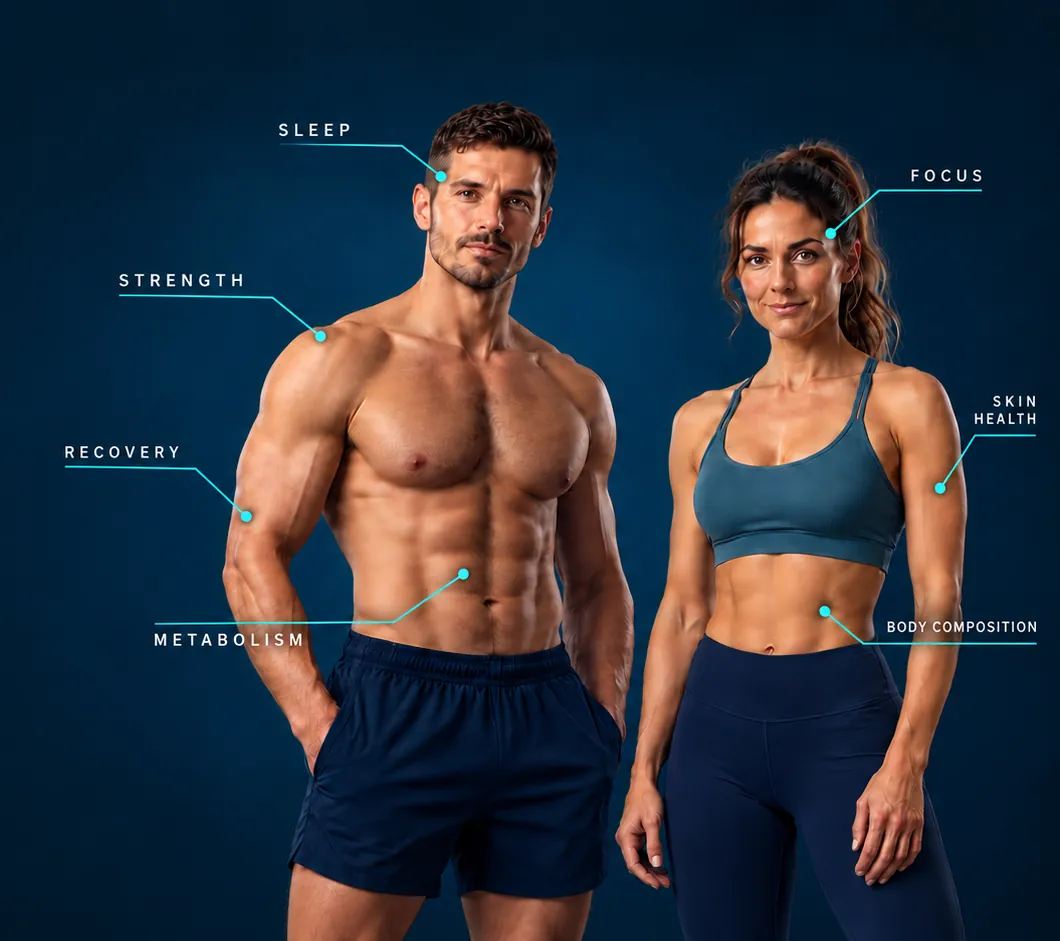
Peptides are short chains of amino acids. Some act as messengers, helping direct functions like recovery, metabolism, and tissue repair.
Your goals are personal. Your care should be too. At RevitaLine, we explore peptide options around your health history and performance priorities—with clinical guidance at every step.
Strength. Recovery. Energy. Confidence.
Explore the options through the goals that matter to you.
The body's own growth hormone, prompted.

The downstream growth factor.

The visceral fat specialist.

The connective-tissue candidate.

The mobility side of recovery.

The short chain at the end of alpha-MSH.

Semaglutide and tirzepatide, medically managed.

Our repair protocol.

The cellular energy coenzyme.

The mitochondrial messenger.

Mitochondrial support for the mind.

The master antioxidant.

Immune signalling, modulated.

A non-hormonal pathway to desire.

Circulation, fuel and connective tissue.

The copper collagen peptide.
Interested in something you don’t see? This page is a starting point, not the whole conversation. Ask a provider — 631-303-3786
Answer a few questions about your goals, your training and how you’re actually feeling. You’ll get a shortlist matched to what you said — and you can bring it straight to your consultation.
About two minutes · 14 questions · results by email
Short chains of amino acids — the same building blocks that make up proteins, only much shorter. Many of them act as messengers, carrying instructions between cells. Your body already makes thousands of them. The ones used in peptide therapy are versions of those same signals, chosen for a particular pathway.
Most goals fall into a handful of groups: recovery and tissue repair, body composition, sleep quality, energy and focus, immune signalling, skin, and sexual health. The formulary above is grouped that way on purpose. What matters is which pathway you are actually trying to influence, and that is a conversation rather than something to pick off a list.
It depends on the pathway and on the person, and anyone giving you a fixed timeline is guessing. Some signals act quickly. Changes in body composition or skin are measured in months rather than days. What is measurable is your lab work, and your plan is adjusted from those numbers rather than from how a particular week felt.
No. HGH is growth hormone itself, given directly. Anabolic steroids are synthetic hormones. Peptides are signalling molecules, and several of the ones here prompt systems you already have rather than replacing anything — so your own feedback loops stay in play. That is usually the distinction people are asking about.
Most are given as a small subcutaneous injection, self-administered at home with a fine insulin syringe. Some are available in oral or topical form instead. Which applies depends on the specific peptide, and the cards above note it where it varies.
That is what the assessment above is for. Fourteen questions about your goals, your training and how you actually feel, matched against the formulary, with the result sent to you by email. It takes about two minutes. It is not a diagnosis and it does not replace a consultation — it gives you something specific to bring to one.
For most plans, yes. Peptides are worked out against what your labs show rather than against how you describe feeling, and several pathways are followed with specific markers afterward — IGF-1, fasting glucose and A1c among them. Without baseline labs there is no way to tell you whether anything actually changed.
Yes. Telehealth visits are available anywhere in New York State, so where you live does not have to decide this. The clinic is at 1111 Broadhollow Road in Farmingdale if you would rather be seen in person, and patients come from across Long Island and the boroughs. Bloodwork is drawn in person either way — here, or at a lab near you.